Slipped Disc Sciatica
- Home
- Slipped Disc Sciatica
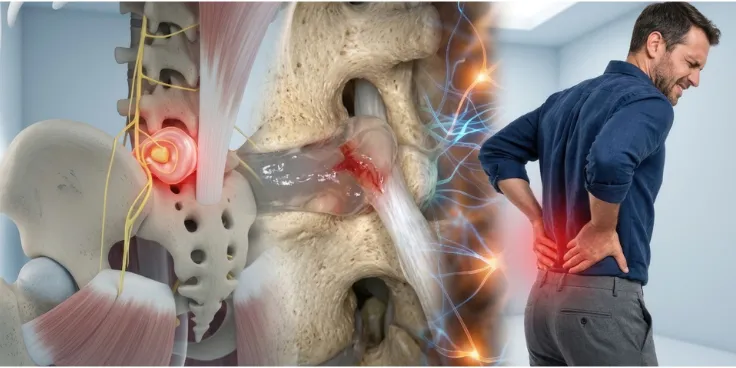
You bend to pick up a bag, feel a sharp twinge in your lower back, and within days a burning pain is running down the back of one leg. Many patients who walk into our clinic describe exactly this. In a large share of these cases, the cause is slipped disc sciatica: a damaged spinal disc pressing on the sciatic nerve.
Reviewed by the spine team at Avee Hospital, explains the causes, symptoms, diagnosis, treatment options and realistic recovery timelines, along with safe ways to relieve pain at home.
If you have ever wondered what a slipped disc is, picture a jam doughnut sitting between each pair of vertebrae. Each spinal disc has a tough outer ring (the annulus fibrosus) and a soft, gel-like centre (the nucleus pulposus). Together, they absorb shock and let your spine bend and twist.
A slipped disc does not actually slip out of place. Instead, the outer ring weakens or tears, and the soft centre bulges or leaks outward. Doctors use several terms for this, and patients often use them interchangeably:
Whether you call it a slipped disc, a herniated disc, or simply a slip disc problem, the concern is the same: displaced disc material can irritate or compress nearby nerve roots. The lower back (lumbar spine) is the most common site because it carries most of your body weight.
The sciatic nerve is the longest in the body. It forms from nerve roots that leave the lower spine (L4 to S3), runs through the buttock, and travels down the back of each leg to the foot.
When a lumbar disc herniates, it can press on one of these roots. The disc material also releases inflammatory chemicals that irritate the nerve even without heavy pressure. The result is radiating pain known as sciatica, or lumbar radiculopathy.
Disc herniation is the leading cause of sciatica, responsible for the majority of cases in adults aged 30 to 50. Other causes include spinal stenosis, spondylolisthesis, and piriformis syndrome, which is why an accurate diagnosis matters.
A disc rarely fails because of one movement. Usually, years of gradual wear make it vulnerable, and a single lift or twist becomes the final trigger. Common causes include:
Many of these factors are within your control, which is why prevention and rehabilitation focus heavily on posture, movement, and fitness.
Symptoms depend on where the disc is damaged and which nerve it affects. Some people with a bulge on an MRI feel nothing at all, while others have severe slip disc pain. Common herniated disc symptoms include:
When these disc problem symptoms appear together, especially leg pain that is worse than back pain, slipped disc sciatica is a likely explanation.
Seek immediate medical help if you notice:
These can signal cauda equina syndrome, a rare but serious condition that needs urgent surgery. Untreated nerve compression can also progress, as explained in our guide to the last stages of sciatica.
The disc between the fourth and fifth lumbar vertebrae (L4-L5) and the one just below it (L5-S1) account for roughly 90–95% of lumbar disc herniations. These levels bear the most load and allow the most movement, which makes them especially vulnerable.
A bulge at this level usually irritates the L5 nerve root. Typical L4-L5 disc bulge symptoms include:
Most L4 L5 disc bulge treatment plans begin conservatively: short-term rest, anti-inflammatory medicines, and a structured physiotherapy programme that strengthens the core and improves spinal mechanics. If pain persists after 6 to 12 weeks, an epidural steroid injection may be considered. Surgery, usually a microdiscectomy, is reserved for persistent or progressive nerve compression.
An accurate diagnosis separates disc-related sciatica from other causes of leg pain. At a specialist consultation, the doctor typically:
Imaging is not always required in the first few weeks. Doctors usually order an MRI if symptoms are severe, persist beyond six weeks, or include red flags.
Around 80–90% of people with slipped disc sciatica improve with non-surgical care within a few months. Treatment follows a step-by-step approach, moving to more advanced options only when simpler ones do not give enough relief. You can explore our full range of sciatica treatments for more detail.
| Treatment | How it helps | When it is used | Typical recovery |
|---|---|---|---|
| Activity modification and short rest | Reduces nerve irritation while staying mobile | First few days of acute pain | 1–3 days of relative rest, then gentle walking |
| Medicines (NSAIDs, muscle relaxants, nerve pain medicines) | Control inflammation, spasm and nerve pain | Early phase, prescribed by a doctor | Relief within days; used short term |
| Physiotherapy and core strengthening | Improves posture, flexibility and spinal support | From week 1–2 onward | 6–12 weeks of regular sessions |
| Hot and cold therapy | Eases muscle spasm and local inflammation | Throughout recovery | Immediate short-term relief |
| Epidural steroid injection | Calms inflamed nerve roots | Pain persisting beyond 6 weeks despite therapy | Relief in days, may last weeks to months |
| Microdiscectomy | Removes disc fragment pressing on the nerve | Severe weakness, red flags, or failed conservative care after 6–12 weeks | Back to desk work in 2–4 weeks; full activity in 6–8 weeks |
| Endoscopic discectomy | Minimally invasive removal through a small incision | Selected cases of contained herniation | Often faster return to work than open surgery |
Surgery is considered if you have cauda equina symptoms, progressive leg weakness or foot drop, or disabling pain that has not improved after 6 to 12 weeks of proper conservative treatment. Studies show that surgery provides faster relief in the short term, though long-term outcomes are often similar to non-surgical care for many patients. The decision should always be personalised.
Many patients ask how to heal a bulging disc naturally. The body can reabsorb herniated disc material over time, and the right daily habits support that process. These self-care measures work best alongside medical guidance:
Natural remedies support healing but do not replace a proper evaluation. If pain is severe or keeps returning, consult a spine specialist.
Bulging disc recovery time varies with the size of the herniation, your age, fitness level and how early treatment begins. A general timeline looks like this:
About 5–15% of people experience a recurrence, which is why continuing exercises and healthy spine habits after recovery is so important.
Book a consultation if your back or leg pain lasts more than two weeks, keeps returning, disturbs your sleep, or comes with numbness or weakness. Early expert care often prevents a manageable disc problem from becoming a long-term one.
At Avee Hospital, patients are evaluated by Dr. (Prof.) Anil K Jain, an experienced orthopaedic and spine specialist, and the team in our orthopaedics department. Care focuses on:
The aim is simple: relieve pain, restore movement and help you return to everyday life safely.
Yes, in many cases. Most people improve within 6 to 12 weeks with rest, activity changes, medicines, and physiotherapy, as the body gradually reabsorbs the herniated material. Ongoing or worsening symptoms still need a doctor’s review.
Gentle walking is usually one of the best activities. It improves circulation, keeps muscles active, and reduces stiffness. Start with short walks on flat ground and increase gradually.
Avoid heavy lifting, bending and twisting together, high-impact sports, and sitting for long periods without breaks. Also avoid prolonged bed rest, which can delay recovery.
Disc-related pain often worsens with sitting, coughing, or bending and may radiate down one leg with tingling or numbness. Only a clinical examination and, if needed, an MRI can confirm it.
No. Fewer than 10% of patients need surgery. It is advised only for severe nerve compression, red-flag symptoms, or pain that does not respond to well-planned conservative treatment.
Yes, recurrence is possible. Regular core exercise, good lifting technique, a healthy weight, and avoiding smoking significantly lower the risk.
Slipped disc sciatica can be painful and frightening, but it is highly treatable. Most people recover fully with timely diagnosis, the right mix of movement and medical care, and a commitment to spine-healthy habits. Do not ignore warning signs such as weakness, numbness or bladder changes.
If leg or back pain is holding you back, schedule a consultation with the spine experts at Avee Hospital for an accurate diagnosis and a treatment plan built around you.