Slip Disc L4 L5
- Home
- Slip Disc L4 L5
You bend to pick up a bag, feel a sharp catch in your lower back, and by the next morning a burning ache is running down one leg. For many people, that is how a slip disc L4 L5 announces itself.
The L4–L5 level is one of the two most common places in the spine for a disc to bulge or herniate, simply because it carries much of the body’s weight and bends more than almost any other segment. The good news: most people improve without surgery when the condition is recognised early and managed correctly.
Prepared with input from the orthopaedic team at Avee Hospital, What a slipped disc actually is, the signs of a slipped disc to watch for, how it is linked to sciatica, the treatment options available, a realistic slipped disc recovery time, and the warning signs that mean you should see a doctor without delay.
Your lower back (lumbar spine) has five bones, numbered L1 to L5. Between each pair sits a rubbery disc that works like a shock absorber. Each disc has a tough outer ring (the annulus) and a soft, gel-like centre (the nucleus).
A slipped disc — also called a slip disc, herniated disc or prolapsed disc — happens when that inner gel pushes through a weak spot or tear in the outer ring. The disc does not actually “slip” out of place. Instead, the bulging material can press on or irritate a nearby nerve root.
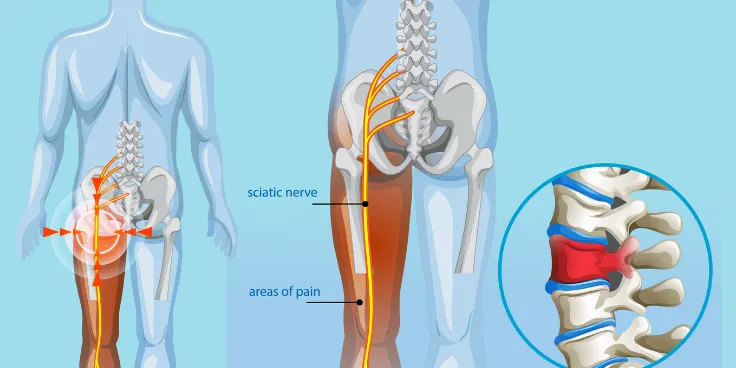
At the L4–L5 level, a disc bulge most often affects the L5 nerve root. This nerve supplies sensation and strength to parts of the leg and foot, which is why a problem in the back can be felt as far down as your big toe.
Why L4–L5 is so commonly affected:
Slipped disc symptoms vary from a dull backache to sharp, electric pain in the leg. Some people have a disc bulge on an MRI and feel nothing at all. When symptoms do appear, these are the most common signs of a slipped disc at the lower spine:
Slipped disc symptoms in the lower back usually start centrally or on one side of the spine. The exact slip disc pain area in the leg depends on which nerve root is irritated — and that is how doctors often tell an L4–L5 problem from an L5–S1 one.
| Feature | Slip Disc L4 L5 (L5 nerve root) | Slip Disc L5 S1 (S1 nerve root) |
|---|---|---|
| Typical pain path | Buttock → outer thigh → outer side of calf → top of foot | Buttock → back of thigh → back of calf → heel and sole |
| Numbness/tingling | Top of foot, big toe, web space between first and second toes | Outer edge of foot, little toe, sole |
| Muscle weakness | Lifting the big toe or foot upward; in severe cases, “foot drop” | Pushing the foot down; difficulty standing on tiptoe |
| Reflex change | Usually none on routine testing | Reduced or absent ankle-jerk reflex |
| How common | One of the two most frequent lumbar levels | The other most frequent lumbar level |
The sciatic nerve is the longest in the body. It is formed from nerve roots that leave the lower spine, including L4, L5, and S1. When a herniated disc presses on one of these roots, the pain travels along the nerve’s path — and that radiating leg pain is what most people call sciatica.
The connection between a slipped disc and sciatica is very strong: a herniated lumbar disc is the most common cause of sciatica in adults. That is why patients often say, “My back is sore, but it’s my leg that’s unbearable.”
Typical features of slipped disc sciatica include:
If you want a deeper look at how these two conditions overlap, read our detailed guide on slipped disc sciatica. Left untreated, severe nerve compression can progress — our plan on the last stages of sciatica explains what that can look like and why early assessment matters.
A slip disc rarely has one single cause. More often, gradual wear combines with a trigger moment.
Common causes and risk factors:
Understanding your own risk factors is useful because many of them — posture, weight, activity, and smoking — can be changed.
Diagnosis starts with a conversation and a hands-on examination — not with a scan. An orthopaedic specialist will usually:
Importantly, MRI is generally not required in the first few weeks unless there are red-flag symptoms or severe weakness, because many disc bulges improve on their own.
Slipped disc treatment follows a stepwise approach. Most patients start with conservative (non-surgical) care, and only a small proportion ever need an operation.
A guided programme of core strengthening, flexibility work, posture correction and nerve-gliding exercises helps relieve pressure on the nerve and prevents recurrence. Some patients also find complementary self-care useful — you can read about acupressure points for sciatica, though this should support, not replace, medical care.
When leg pain persists despite medicines and physiotherapy, an epidural steroid injection or selective nerve root block may reduce inflammation around the nerve and create a window for rehabilitation.
Surgery, such as microdiscectomy or endoscopic discectomy, removes the portion of disc pressing on the nerve. It is usually considered when there is progressive weakness, cauda equina syndrome, or disabling pain that has not improved after about 6–12 weeks of proper conservative care.
| Treatment option | When it is typically used | Usual goal |
|---|---|---|
| Activity modification + medicines | Early stage, mild to moderate pain | Control pain and inflammation |
| Physiotherapy | After the acute phase settles | Restore movement, strengthen core, prevent recurrence |
| Epidural / nerve root injection | Persistent leg pain despite conservative care | Reduce nerve inflammation |
| Microdiscectomy / endoscopic surgery | Progressive weakness, red flags, or no improvement after 6–12 weeks | Relieve nerve compression |
For a full overview of non-surgical and surgical options, see our page on sciatica treatments. The right plan depends on your symptoms, examination and imaging — which is why individual consultation matters.
One of the first questions patients ask is, “How long will this take?” Slipped disc recovery time differs from person to person, but a general pattern looks like this:
| Phase | Approximate timeframe | What usually happens |
|---|---|---|
| Acute phase | First 1–2 weeks | Pain is most intense; focus on pain control and gentle movement |
| Early recovery | 2–6 weeks | Leg pain gradually eases; physiotherapy begins |
| Rebuilding phase | 6–12 weeks | Most people notice clear improvement and return to routine activities |
| After surgery (if needed) | 2–6 weeks for light work; longer for heavy work | Guided rehabilitation to rebuild strength |
This is an honest question that deserves an honest answer. In many cases, yes — symptoms can settle completely. The body can gradually reabsorb part of the herniated disc material, and nerve irritation often calms down within weeks to a few months.
However, a disc that has herniated once may remain more vulnerable. “Cured” in practice usually means living pain-free and active, while protecting your spine through good posture, regular exercise, and safe lifting habits. No responsible doctor can promise a guaranteed outcome, but timely, correct treatment gives you the best chance of a full return to normal life.
Most slip disc pain can be managed in a planned way. But some symptoms suggest serious nerve compression and need same-day medical attention:
The first two signs can point to cauda equina syndrome, a surgical emergency.
Book a routine consultation if:
Whether you are recovering or simply want to lower your risk, these habits support a healthy lower back:
At the Orthopaedics Department of Avee Hospital, patients with back pain and sciatica are assessed through a careful clinical examination, appropriate imaging, and a treatment plan suited to their condition and lifestyle. The approach is conservative-first: surgery is discussed only when it is medically indicated.
The orthopaedic team is led by Dr. (Prof.) Anil K Jain, who evaluates spine and joint conditions and guides patients through options ranging from physiotherapy-based care to surgical treatment when required. Each decision is made together with the patient, after explaining the benefits, limitations and risks of every option.
If you are experiencing lower back pain with leg symptoms, you can find Avee Hospital on Google for directions and contact details to schedule a consultation.
In most cases, it is painful but not dangerous, and many people improve with non-surgical care. It becomes serious if there is worsening leg weakness, bladder or bowel changes, or saddle numbness — these need urgent medical attention.
Both are lower back disc problems. An L4–L5 disc usually affects the L5 nerve, causing pain on the outer leg and top of the foot. A slip disc L5 S1 usually affects the S1 nerve, causing pain at the back of the calf, heel, and sole.
Yes, gentle walking is usually encouraged once severe pain settles. It keeps the spine moving and improves blood flow. Stop and consult your doctor if walking makes leg pain significantly worse.
Avoid heavy lifting, bending forward repeatedly, twisting movements, sitting for long periods, and high-impact exercise until your doctor or physiotherapist advises otherwise.
Many do. A large proportion of patients with a slipped disc improve within 6–12 weeks through medicines, activity changes and physiotherapy. Surgery is reserved for specific situations.
Usually not. Sciatica caused by a disc often fades as nerve inflammation reduces. Long-lasting or severe nerve compression, however, can leave lingering numbness or weakness, which is why timely assessment is important.
An orthopaedic specialist or spine surgeon is the right starting point. They can confirm the diagnosis and coordinate physiotherapy, pain management and, if needed, surgery.
A slip disc L4 L5 can make simple things — sitting, walking, sleeping — feel exhausting. Yet with an accurate diagnosis and a structured, step-by-step plan, most people return to their normal routine without surgery. Recognise the signs early, stay gently active, follow guided physiotherapy, and never ignore red-flag symptoms.
If back or leg pain is affecting your daily life, consider an evaluation with the orthopaedic team at Avee Hospital to understand what is causing your symptoms and which treatment suits you.