Acupressure Points for Sciatica
- Home
- Acupressure Points for Sciatica
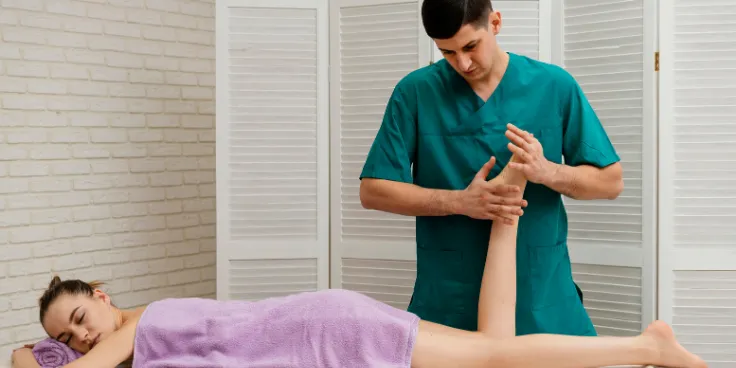
If you have ever felt a sharp, burning pain shoot from your lower back through your buttock and down one leg, you already know how disruptive sciatica can be. Some people describe it as an electric shock. Others feel a dull ache, tingling or numbness that makes sitting through a meeting or a car ride feel impossible.
While medical care remains the foundation of treatment, many patients look for gentle, drug-free ways to manage flare-ups at home. That is where acupressure points for sciatica come in. Acupressure uses steady finger pressure on specific spots of the body to help relax tight muscles, calm pain signals and improve circulation.
We walk you through five easy-to-find points, how to press them correctly, who should avoid them, and when a flare-up needs a doctor rather than a home remedy. The advice reflects the spine-care approach followed at Avee Hospital, where patients are guided on combining self-care with proper medical evaluation.
Sciatica is not a disease on its own. It is a set of symptoms caused when the sciatic nerve, the longest nerve in the body, is compressed or irritated. This nerve starts from roots in the lower spine (L4 to S3), runs through the buttock and travels down the back of each leg to the foot.
Many people search for the “sciatica disease”, but doctors view it as a sign of an underlying spinal or muscular issue. Finding that root cause matters, because the right treatment depends on it.
A typical sciatica problem affects only one side of the body. Watch for radiating pain from the lower back to the calf or foot, tingling or “pins and needles”, numbness, leg weakness, and pain that worsens when you sit, cough or sneeze. If you feel nerve pain in back that stays on one side, especially the lower right or left, it is worth getting it assessed early.
Acupressure comes from Traditional Chinese Medicine and works on the same points used in acupuncture, but with fingers instead of needles. From a modern medical view, firm pressure is thought to relax muscle spasm, improve local blood flow and trigger the release of the body’s natural pain-relieving chemicals, such as endorphins.
Acupressure has not been studied as rigorously, so it is best seen as a supportive tool. It can ease muscle tension and help you feel more in control during a flare-up. It does not repair a damaged disc or remove pressure from a trapped nerve root.
Before you start, sit or lie in a comfortable position and take a few slow breaths. Use your thumb, fingertips or knuckle. Press firmly enough to feel a dull, “good” ache, never sharp pain. Hold each point for 1 to 2 minutes while breathing deeply, then repeat on the other side.
Where to find it: Lie on your side with the painful side up. Find the point about one-third of the way between the top of your thigh bone (the bony bump on your outer hip) and the base of your spine.
How to press: Use your thumb or a tennis ball against a wall. Apply steady pressure for 1 minute, then make slow circles.
Why it helps: GB30 sits close to the piriformis muscle and the path of the sciatic nerve. Releasing tension here often brings relief to buttock pain that travels down the leg.
Where to find it: In the exact centre of the crease behind your knee.
How to press: Sit with your knee slightly bent. Use gentle pressure only, since this area has blood vessels and nerves close to the skin. Hold for 1 minute.
Why it helps: Traditional practice links BL40 with low back and leg pain. Many people find it eases stiffness in the hamstrings that pull on the lower back.
Where to find it: On the lower back, about two finger-widths on either side of the spine, at waist level (roughly in line with your belly button).
How to press: Place both fists or thumbs on the points while sitting upright. Press and rub gently for 1 to 2 minutes.
Why it helps: BL23 lies over the lumbar muscles that often tighten during a flare-up. Relaxing them can reduce strain around the irritated nerve roots.
Where to find it: On the outer side of the lower leg, in the small hollow just in front of and below the head of the fibula (the bony knob below the outer knee).
How to press: Press with your thumb for 1 minute, then massage in small circles.
Why it helps: GB34 is traditionally used for muscle and tendon problems. It may ease cramping and tension along the outer leg, where sciatic pain often travels.
Where to find it: In the hollow between the outer ankle bone and the Achilles tendon.
How to press: Squeeze gently between thumb and index finger for 1 minute.
Why it helps: BL60 is used for pain that reaches the heel and foot, as well as low back stiffness. Avoid this point during pregnancy.
Simple routine: Work through all five points once or twice a day. Pair the session with a warm compress and light stretches, such as a knee-to-chest stretch or a seated piriformis stretch, for better results.
Save this table for your daily routine. It sums up where each point is, how long to hold it and who should skip it.
| Point (code) | Location | Hold time | Best for | Caution |
|---|---|---|---|---|
| Huantiao (GB30) | Outer buttock, between hip bone and base of spine | 1–2 min per side | Buttock pain radiating down the leg | Avoid on bruised or inflamed skin |
| Weizhong (BL40) | Centre of the crease behind the knee | 1 min, light pressure | Low back stiffness, tight hamstrings | Skip if you have varicose veins or a known clot |
| Shenshu (BL23) | Two finger-widths beside the spine at waist level | 1–2 min | Lower back tension | Avoid directly over a recent injury or surgery site |
| Yanglingquan (GB34) | Hollow below and in front of the outer knee bone | 1 min | Outer leg cramping and tension | Use gentle pressure if the area is numb |
| Kunlun (BL60) | Between outer ankle bone and Achilles tendon | 1 min | Pain reaching heel and foot | Avoid during pregnancy |
Acupressure is low-risk for most adults, but it is not right for everyone. Check with your doctor first if you:
Some symptoms suggest serious nerve compression. Seek urgent medical care if you notice:
In these situations, an experienced sciatica specialist can order the right tests, such as an MRI or nerve conduction study, to confirm what is pressing on the nerve.
One of the most common questions patients ask is how to cure sciatica permanently. The honest answer is that lasting relief comes from treating the cause, not just the pain. Around 80 to 90 percent of people improve with conservative care within a few weeks to months. The rest may need more targeted treatment.
A well-rounded plan usually moves step by step:
Prevention keeps the results going. Maintain a healthy weight, lift with your knees rather than your back, take breaks from sitting every 30 to 45 minutes, and keep up your core exercises even after the pain settles.
At Avee Hospital, sciatica care begins with a detailed examination to find the true source of pain. Under the guidance of Dr. (Prof.) Anil K Jain, patients receive a personalised plan that may include physiotherapy, pain management, lifestyle advice and, only when truly needed, advanced spine surgery.
The goal is simple: help you return to walking, working and sleeping without the shadow of nerve pain. You can explore the full range of sciatica treatment options or book a consultation to discuss your symptoms.
Many people feel short-term relief from muscle tension and pain. Strong evidence exists for acupuncture in chronic sciatica, while acupressure research is still limited. Use it alongside medical treatment, not as a replacement.
Once or twice a day is enough for most people. Hold each point for 1 to 2 minutes. Stop if the pain becomes sharper or spreads.
Most acute episodes improve within 4 to 6 weeks. Pain that lasts beyond 12 weeks is considered chronic and needs a proper medical evaluation.
A herniated or bulging disc in the lower spine is the leading cause. Spinal stenosis, piriformis syndrome and spondylolisthesis are other frequent reasons.
Some points, including Kunlun (BL60), are traditionally avoided during pregnancy. Always speak to your obstetrician before trying acupressure while pregnant.
See a doctor if pain lasts more than a few weeks, affects both legs, causes weakness, or comes with bladder or bowel changes. The last sign needs emergency care.
No. Most patients recover with conservative care. Surgery is considered only when there is severe nerve compression, worsening weakness or pain that does not respond to other treatment.
Sciatica can make simple things, like tying your shoes or sitting through dinner, feel exhausting. The five acupressure points for sciatica covered here (GB30, BL40, BL23, GB34 and BL60) offer a gentle, drug-free way to ease tension and take the edge off a flare-up at home.
Still, pressure points work best as part of a bigger plan. If your pain keeps returning, spreads to both legs or comes with weakness, do not wait it out. A timely visit to the spine team at Avee Hospital, led by Dr. (Prof.) Anil K Jain, can uncover the true cause and set you on the right path to long-term relief.