ACL Injury Recovery Time
- Home
- ACL Injury Recovery Time
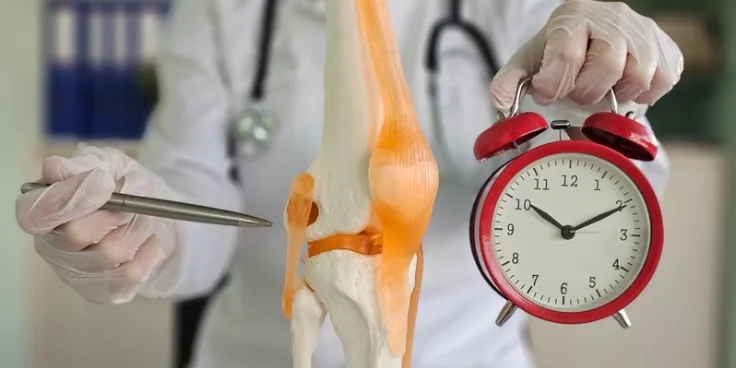
It usually happens in a split second. A sharp turn during a football match, an awkward landing on the badminton court, or a slip on a wet staircase. Many people describe hearing or feeling a “pop” inside the knee, followed by swelling within a few hours and a strange sense that the joint can no longer be trusted.
Once the shock settles, almost every patient asks the same thing: How long before I’m back on my feet? The honest answer is that ACL injury recovery time depends on how badly the ligament is damaged, whether you need surgery, and how committed you are to rehabilitation. A mild sprain may settle in a few weeks, while a full reconstruction followed by a return to competitive sport typically takes nine months to a year.
The orthopaedic team at Avee Hospital, Vaishali, Ghaziabad, walks you through each stage of healing, what affects your timeline, and the warning signs that deserve medical attention, so you know exactly what to expect.
The anterior cruciate ligament (ACL) is a strong band of tissue that runs diagonally through the middle of the knee, connecting the thigh bone (femur) to the shin bone (tibia). Its main job is to stop the shin bone from sliding forward and to control twisting movements. Without it, the knee may “give way” whenever you pivot, change direction, or step off a curb at an odd angle.
An ACL injury occurs when this ligament is stretched or torn. Most tears are non-contact injuries, meaning nobody else is involved. They typically happen when:
Doctors grade these injuries by severity:
Around half of ACL tears come with damage to other structures, such as the meniscus (the knee’s shock-absorbing cartilage), the medial collateral ligament, or the joint surface. These “companion” injuries often influence both treatment and healing time.
Plenty of people walk on an injured knee for weeks, assuming it’s a simple sprain. Because a missed tear can lead to repeated giving way and further cartilage damage, it helps to recognise the common ligament tear symptoms early:
An orthopaedic surgeon will usually confirm the diagnosis with a clinical examination, such as the Lachman test, which checks how far the shin bone moves forward. An MRI scan then shows the extent of the tear and reveals any injury to the meniscus or cartilage. X-rays help rule out bone damage.
Every knee heals at its own pace, but the following table gives realistic timelines based on the severity of the injury and the treatment chosen. Treat these as general ranges rather than fixed deadlines.
| Injury Type / Treatment | Typical Recovery Period | Return to Daily Activities | Return to Sport |
|---|---|---|---|
| Grade 1 sprain (conservative care) | 2 to 4 weeks | 1 to 2 weeks | 3 to 6 weeks |
| Grade 2 partial tear (bracing + physiotherapy) | 6 to 12 weeks | 2 to 4 weeks | 3 to 4 months, if the knee is stable |
| Grade 3 complete tear (non-surgical) | 3 to 6 months | 4 to 8 weeks | Generally limited to low-pivot activities |
| ACL reconstruction surgery | 9 to 12 months | 2 to 6 weeks (desk work), 3 to 4 months (physical jobs) | 9 to 12 months after passing functional tests |
| ACL reconstruction with meniscus repair | 9 to 12+ months | 6 to 8 weeks | 10 to 12 months |
Research on athletes has repeatedly shown that returning to pivoting sports before nine months after surgery is linked to a noticeably higher chance of tearing the ligament again. That’s why surgeons focus less on the calendar and more on whether your strength, balance, and hop-test results have reached safe levels.
A completely torn ACL does not heal back together on its own, because the ligament sits in joint fluid that prevents a stable blood clot from forming. For young, active people, those with physically demanding jobs, and anyone whose knee keeps giving way, reconstruction is usually advised.
Modern knee ligament surgery is performed arthroscopically, through a few small keyhole incisions. Rather than stitching the torn ends together, the surgeon replaces the ligament with a graft, most commonly taken from:
The graft is passed through tunnels drilled in the femur and tibia and fixed with screws or buttons. Most patients go home within a day or two. Over the following months, the body gradually turns this graft into living, ligament-like tissue, a process called “ligamentisation” that continues for well over a year. This biology is the main reason rehabilitation can’t be rushed, even when the knee feels fine.
The ACL tear recovery time after surgery is best understood as a series of phases. Each one has clear goals, and you move forward only when you meet them.
The priority is controlling pain and swelling with ice, elevation, and compression. You’ll start gentle exercises like quadriceps tightening, ankle pumps, and heel slides. Achieving full straightening of the knee early on is one of the most important goals of the entire recovery. Most patients walk with crutches and a brace during this period.
Swelling settles, and bending usually improves toward 110 to 120 degrees. Many patients stop using crutches by the end of this stage. A stationary bike, mini-squats, and balance work are added gradually. People with desk jobs often return to work during this window.
This is where real muscle rebuilding begins. Leg presses, step-ups, bridges, and controlled lunges help strengthen the quadriceps and hamstrings. Walking feels close to normal, though stairs may still feel weaker on the operated side.
If strength and swelling allow, a supervised jogging programme typically begins around three to four months. Agility drills, light plyometrics, and single-leg balance exercises are introduced step by step.
Cutting, pivoting, and sport-specific drills are added slowly. Before you’re cleared for competitive sport, your physiotherapist and surgeon usually check strength symmetry (aiming for 90% or more compared with the uninjured leg), hop tests, and your confidence in the knee. Psychological readiness matters too; fear of reinjury is common and is worth discussing openly.
It’s natural to compare your progress with a friend or teammate, but the knee ligament injury recovery period varies widely from person to person. The main factors include:
Not every ACL injury ends in the operating theatre. Non-surgical knee ligament tear treatment can work well for partial tears, older adults with lower activity demands, and people who don’t play pivoting sports. A conservative plan usually includes:
The key is careful monitoring. If the knee continues to buckle despite good rehabilitation, surgery may be recommended later to protect the meniscus and cartilage from further damage.
Ligaments are present in nearly every joint, and injuries elsewhere follow similar principles. Sometimes, instead of the ligament tearing, it pulls away a small fragment of bone where it attaches. Patients often call this a “ligament fracture”; medically, it’s known as an avulsion fracture. It’s common in teenagers, whose bone attachment points are weaker than the ligaments themselves, and it may be treated with immobilisation or with surgical fixation of the bone fragment.
In the shoulder, falls onto the outer shoulder during cycling, sport or road accidents can damage the coracoclavicular ligament, which helps hold the collarbone in place. Severe injuries can leave a visible bump at the top of the shoulder and may require surgical reconstruction.
Whatever the joint, timely assessment and the right ligament injury treatment help prevent long-term instability and early arthritis.
Some setbacks are avoidable. Watch out for these:
Contact your doctor promptly if you notice:
Recovering from an ACL injury goes far more smoothly with an experienced team guiding each phase, from the first examination to the day you’re cleared for sport. At Avee Hospital, a well-regarded orthopedic hospital in Ghaziabad, patients have access to in-house X-ray and MRI imaging, modern operating theatres for arthroscopic surgery, and a dedicated rehabilitation unit under one roof.
The orthopaedic department is led by Dr. (Prof.) Anil K Jain, Head of Orthopaedics, who holds an MBBS and MS in Orthopaedics and brings over four decades of experience in joint surgery, arthroscopy, trauma care, and sports injuries. His approach starts with understanding each patient’s lifestyle and goals, whether that’s walking comfortably, returning to a physical job, or getting back to competitive play, and building a plan around them.
If you’re struggling with knee pain, swelling, or instability after a twist or fall, explore our knee ligament injury treatment options or book an OPD consultation (Monday to Saturday, 10:00 AM to 1:00 PM) with the orthopaedic team.
Most people return to daily activities within six to eight weeks, to jogging around three to four months, and to pivoting sports between nine and twelve months after reconstruction, once they pass strength and functional tests.
Often, yes. Many people can walk once the initial swelling settles, but the knee may give way during twisting movements. Walking without assessment can risk further damage to the meniscus and cartilage.
A partial tear may heal with bracing and physiotherapy. A complete tear does not reattach on its own, though some people with low activity demands manage well with strengthening alone.
If your left knee was operated on and you drive an automatic car, you may be able to drive within two to three weeks. After right-knee surgery, it’s usually four to six weeks, once you’re off strong painkillers and can brake safely.
Desk-based workers often return in two to four weeks. Jobs involving standing, lifting, or climbing generally need three to four months.
Discomfort is expected for the first one to two weeks and is well controlled with medication, ice, and elevation. Pain decreases steadily as swelling settles.
Repeated episodes of instability can damage the meniscus and joint cartilage over time, increasing the risk of early osteoarthritis.
There is no single number that answers “how long does an ACL take to heal?” A mild sprain may settle in a month, while a full reconstruction asks for patience over nine to twelve months. The good news is that most people who follow a structured rehabilitation plan return to the activities they love with a stable, confident knee.
Understanding your ACL injury recovery time helps you set realistic goals, avoid shortcuts, and celebrate each milestone along the way. If your knee hasn’t felt right since a fall or a twist, don’t wait for it to “settle down.” An early evaluation is the first step toward a full recovery.